Did you come to this web page just for the airline links? If so, they are at the bottom of this page and you can click here for the airline section (or click on the airplane image, or use the “Airline Links” menu button in any of the horizontal menus).
Adopting a Pet in Anguilla - the Basics
Take a loving part of your visit to Anguilla back home with you!
If you live on Anguilla (as we say), adopting from AARF comes with the knowledge that your new pet has been professionally examined by the Morlens veterinarian staff and applicable medications have been given.
Visitors: while you are enjoying your visit to Anguilla, think about taking a special memory back home with you — a new addition to your family (or even someone you know who would love a new pet). It's easy, and this page will tell you what you need to know. Read on for the full details.
Consider this: once back home, every time you look into those eyes, a part of Anguilla will look back at you. Don't just take our word for it: read the "Happy Tails" sections of our newsletters.
This page is for anyone wanting to adopt a pet in Anguilla, whether she stays here on island, or moves to a new home abroad.
(We mostly will use the female form when describing animals, just because we decided to pick one versus having to put he/she/it in every sentence, and, besides, it's harder to find homes for girl dogs and cats.)
How do I Adopt? Why Should I Adopt from AARF? What will it cost?
The simplest way is to come in to the AARF shelter and select a deserving puppy, kitten, dog or cat. You have a new family member!
If you have a computer and want to check us out beforehand, we'll often have photos on this web site — we put thumbnail photos on the main page and more detailed notes and photo on the Available for Adoption page. And if you get our announce-only emails, you will often get descriptions and photos.
You should contact us by phone or email with any questions you may have.
Why AARF?
You should adopt from AARF, because you'll be getting a new pet that has been examined for health and adoptability and treated by the vets before being put up for adoption. He or she will be getting food, water and care from the shelter and volunteers will try to socialize her as much as possible.
Most importantly, you'll be saving an animal that was surrendered or otherwise not wanted.
As a bonus, your new pet will come with initial vaccinations, treatments and a medical history. If leaving Anguilla, AARF and Morlens can help with needed paperwork for your home country — and more.
What will it cost?
The adoption fee is US$25 for dogs, US$20 for cats, and that includes a wide array of built–in services and benefits, including:
- Vet exam
- First vaccination (up to 3 will be needed, depending on age)
- First deworming
- Spay/neuter surgery when the pet is old enough (typically around six months of age) if the pet continues to stay on Anguilla
- Two coupons offering a discount off the cost of the second and third set of vaccinations (each coupon is good for $10 off). These coupons would only work for any pet staying on Anguilla long enough to get the vaccinations (three sets are needed on a certain timeline, generally three weeks apart)
- Initial flea and tick treatment
This low adoption fee, while bundling several services, covers only a small portion of the cost of examining, treating and caring for the animals and the surgery. In other words, this adoption package provides a lot of value for the money!
The low cost is possible because AARF is funded (and solely funded) through the graces of people who pay membership dues, give donations, and participate in our fund raising efforts. We are extremely thankful to them for supporting us and allowing us to provide such an outstanding adoption package amongst our various services.
However, animals leaving Anguilla will probably have other requirements, such as a rabies vaccination and paperwork required by your home country (such as a health certificate for the USA). This will result in extra charges. For example, a health certificate costs about US$35 and takes about a half hour to prepare.
If a carrier is needed, AARF has those for sale.
You'll also have to verify that your airline will take your new pet and make a special reservation for her. Airlines like their add–on fees and those that take pets will typically charge an extra fee. Also, while they may not charge for it, they will also want you to make a reservation or get a locator number for your pet.
Getting to our Shelter
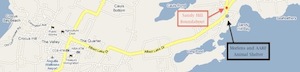
The Morlens Veterinary Clinic and the AARF Shelter are located in Sandy Hill on the Long Path Road near the Sandy Hill Roundabout (here is a map). Call the AARF cell phone (which has voicemail) during our operating hours. After hours, you can leave a message. Or, send us an email.
I Want to Adopt an Anguillian dog or cat and take her home. How easy is It?
Very easy, in fact.
Many people have fallen in love with Anguillians dogs and cats, adopted and taken them back to the USA, Canada, even to Europe. We have even have multiple cases where people have more than one pet that came from Anguilla (sometimes via repeated visits)!
Here is a great factoid:
In 2010, we saw (and helped with) 25 adoptions to the USA!
We want to continue that trend, and have those numbers go up. So far, we are on track in 2011.
Adopting a dog or cat and taking it back to the United States from Anguilla is easy. AARF and the Morlens Veterinary Clinic can help.
In this section, we will give as much information as we can (including a detailed example of shipping a puppy in a crate to Chicago), but the reader will need to check with each country and airline to get the latest regulations and find out what paperwork is required. We list some helpful links at the bottom of this page.
While we have many successful and happy adoption stories, we are most familiar people with taking their new pets to the United States; therefore, that is mostly what this section covers. We found a Canadian web site that talks about importing dogs and cats (see below), and adoptions to Canada appear to work in a straightforward manner.
We've also had successful adoption of kittens to Germany and Switzerland, but European Union rules appear to be more strict than for North America (for example, there appear to be requirements for pet passports and microchips, which seem to be available in St. Martin).
We would like to hear from those who have adopted and taken pets abroad, especially how it went with the airlines and various government entities. If you have tidbits we can pass on, please send us a pre-addressed email with the details.
Where to start?
The first step is easy: find a puppy, dog, cat or kitten that you would love to give a second chance and a forever home.
We recommend you come by the shelter and adopt one our our deserving animals. We almost always have deserving puppies/dogs/kittens/cats there who would love to join a caring family. And if you get her from AARF, she will have had an examination for health, been dewormed and de-ticked (is that a word?), vaccinated as needed and often socialized by AARF volunteers.
Animals leaving Anguilla will have other requirements, such as rabies shots (for dogs of a certain age) and paperwork such as a health certificate (which your home country will probably want).
A health certificate runs about $35 U.S. dollars. It takes less than a half hour to be prepared by the vet, but if the shelter is busy, or an emergency occurs, it can take longer, so it is recommend this be done at least a day before you leave, taking the operating hours of the clinic in mind.
And you'll need her existing medical records for your regular vet, which will be given to you when you come to Morlens and finalize the adoption.
If a carrier is needed, AARF has those for sale.
You'll also have to verify that your airline will take your new pet. Airlines that do will typically want to charge an extra fee and require a reservation or locator number for the pet. See below for links to various airlines. Also please note that pets that go inside the cabin can't be in exit rows or bulkhead seats.
But…I found a stray kitten at my Villa and I want her!
At times, however, island visitors find an animal on the beach, on the road or at their villas, fall in love and decide to save her. We've had many great happy endings in those situations, and many unwanted animals have found great new homes and families. There are a couple of complicated issues to deal with, though.
First, once the decision has been made to adopt, this step is critical: make sure the pet isn't owned by someone! The animal may have wandered into a villa or gotten loose from a neighbor. Many local pets don't wear collars or tags, and many yards are not enclosed, so animals roam.
If you have a possible candidate for adoption at your hotel or villa, ask around: ask the property owners, the caretaker staff and any neighbors, for example. Ask if the animal is available for adoption. Only when you are sure the pet is not owned by someone should you proceed with the adoption.
Next, decide if your airline will take your new pet and make the appropriate reservations.
Finally, and most importantly: loose strays are almost certain to have worms, ticks, fleas, and can also suffer from maladies such as Heartworm, Ehrlichiosis, skin diseases, fung,i etc., This is the tropics and parasites and diseases are around!
In such cases, you'll want to do testing for diseases, get a flea/tick treatment and get the required paperwork. In those cases, fees for vaccinations and especially treatments may be higher than the fees AARF charges.
To do this, make an appointment with Morlens Veterinary Hospital so that you can take your new pet in for a full exam, blood and other tests, treatments, shots (including a rabies shot if it's a dog that's old enough) and the health certificate for travel from Anguilla. Please allow enough time for this to be done, as this is a fairly involved office visit to get all this done. We suggest this be done at least a day before you leave taking in mind the operating hours of the clinic.
Transporting your pet on an airline: an Overview
Airlines generally make taking dogs to the United States easy. We've had good luck with American Airlines, as well as Continental.
Things to consider are:
- How you will take your pet home (through which towns, countries and airports)
- Airport temperatures from the start to your final destination
- Pet–friendly hotels
- Country regulations
Let us start with leaving Anguilla. Flying from Anguilla using one of the local air services is likely to be trouble free — if they take pets. Please check with them. There is air service from Anguilla to Sint Maarten as well as Puerto Rico. Local air services include: Anguilla Air Express (aka Rainbow Air), Anguilla Air Services and Cape Air.
Many people depart from the Sint Maarten airport (Princess Juliana or airport code SXM), using a ferry from Anguilla. The choice then is: ferry to the Dutch side where the airport is, or go to Marigot (what the webmaster calls “France”).
We have found that getting to the St. Maarten airport works well if you go directly to the Dutch side. This entails a Anguillian local ferry service, of which there are several. It just seems to be the easiest. They'll take you to the airport from the Dutch Immigration station (taxi is built in; all you need to do is tip), and you avoid having to get a taxi from Marigot to the airport.
That said, we haven't heard of problems yet from in–transit passengers going to Marigot on the French side (that is, those who are en route to the airport). Someday, though, they could invoke the European Union animal transport rules, which among other things, requires a pet passport (yes, a real passport!), a micro-chip (which your new pet won’t have), etc.
Generally, however, your pet will need to be current on vaccinations, been examined by a vet and have the required paperwork (such as a health certificate); these can be taken care of at Morlens Veterinary Clinic.
If a dog is of a certain age, a rabies vaccination will probably be needed. Anguilla is a rabies–free country, which will be put on your health certificate, but countries such as the USA have rabies shot requirements.
Small animals, such as kittens, small cats, puppies or tiny dogs can go inside the cabin.
Bigger animals have to go in the airplane's cargo hold, essentially as checked baggage.
Airlines may or may not allow you to take animals either on board or in the hold, so it is imperative to first check with them. In particular, make sure small independent airlines and charters will take pets.
We've had success stories with large mainstream airlines; two examples are American Airlines flying from Sint Maarten and San Juan to US cities such as Miami and Chicago as well as Continental flying from St. Maarten to Boston (via NY).
We have never heard of it being possible to “send” a dog or cat on an airline unaccompanied. We think an escorting passenger is needed. This is likely due to security reasons, although the airlines and destination country might have other reasons. Check with the airline and country Immigration policies.
Tell us how it went!
We are always interested in what happens when people take pets from Anguilla, whether it goes smoothly or not!
Use this pre-addressed email to send an email to our general email account with your story! (If it does not work, please use our General email link on our Contact Us page.)
For pets traveling inside the cabin
For pets small enough to ride in the cabin, a soft carrier is ideal, as it allows it to fit under the seat while giving the pet the most room possible, although airline–approved hard carriers are legal as well.
Either way, pets must fit comfortably in the carrier (they must be able to move around), and must be able to fit completely under the seat in front of you.
Make sure you have not booked an emergency exit row, bulkhead or other seat that won't allow the carrier to be on the floor during parts of the flight.
Airlines will likely charge a fee for you to transport your pet. For in–cabin pets, by the way, the pet carrier counts as one of your carry–ons.
If you plan to adopt a small puppy or kitten that can go inside the airplane before coming to Anguilla, AARF recommends that you consider buying and bringing a soft–sided carrier with you. It will be easier and cheaper. Pet carriers and crates of any kind are extremely difficult to locate in Anguilla, which is why we advise you to bring one. That said we try to have a small supply of soft carriers and hard crates for sale. Unfortunately buying and then shipping those crates and carriers to Anguilla (and paying Customs duties on them) increases the costs for the carriers.
We have a nice checklist for in-cabin pets in two formats, Microsoft Word and PDF:
If you have a puppy too young to be vaccinated (or one whose vaccination isn’t effective yet), you may also need a filled out CDC Rabies Confinement Agreement form (PDF). (Note: you can also download it from the CDC web site.)
For Pets traveling in the Cargo Hold
Bigger animals have to go in the airplane's cargo hold as checked baggage.
A larger animal in a crate may incur an over–sized baggage charge as well. Airlines may also have a maximum weight and size limit. Please see your airline's web page that covers transporting pets. We list several at the bottom of this page.
May 5th, 2011 warning: With American Airlines now using 737s around the Caribbean as opposed to the larger 757s (including flights from Sint Maarten to Miami), be advised that there is a 28" height limitation on kennels for 737 aircraft.
At least one passenger trying to fly to Miami ran into rigid and unbending airline personnel — and was forced to reroute via JFK, because that flight used the larger 757. This limit would apply largely to larger dogs requiring larger crates.
There are document and signage you have to attach to the crate, as well as the need for food and water dishes, and cable ties. The signage is made with ordinary paper and hardy tape.
Here is a checklist for crated pets that will go into the cargo hold (in Word or PDF formats):
If you have a puppy too young to be vaccinated (or one whose vaccination isn’t effective yet), you may also need a filled out CDC Rabies Confinement Agreement form (PDF). (Note: you can also download it from the CDC web site.)
For Checked Pets: Cargo Hold Temperature Limits
At certain times in the year — primarily when the temperature gets too high (or too low) for any airport in the flight's itinerary — airlines will refuse to transport animals in the hold. This is to prevent dehydration and heat stroke on one end and cold related problems on the other end. At the end of this article, we list links to various airlines and their traveling with animals pages which should list their requirements.
For example, as of this writing, the high temperature threshold for American Airlines is 85 degrees Fahrenheit, 29.4 degrees Celsius for most animals. American and other airlines often cite a different temperatures for “snub–nosed” dog breeds. To continue our example, American has an upper limit of 75 degrees Fahrenheit for snub nosers.
In particular, that means from the Spring until it gets cooler later in the year, it can be risky if you try and transport a pet in hot weather. Flying early in the morning helps. Note that a passenger jet has a pressurized and temperature controlled hold; inter–islander prop planes such as the planes used by American Eagle and LIAT do not, and neither would any company that uses smaller airplanes.
On the other end of the thermometer, there is a low (cold) temperature limit. We've seen temperature limits of 45 degrees Fahrenheit for some airlines. If it will be colder than that at any point along the airline's path, the airline may decree that the animal cannot go into the hold. It is imperative to double check with the airline before booking the pet reservation to find out if there will be a problem.
Airline Reservation for your pet
Typically, you have to make an airline reservation for your pet, just as you do for yourself.
For example, American assigns a separate Record Locator (besides yours) to the pet. It will be linked to your Record Locator.
Checked pets may not need a reservation, but at least American has a first–come, first–served policy on taking checked animals. It seems that they seem to have a limit on how many animals can go on one flight. We don't know what that might be, but on one trip from St. Maarten a couple Junes ago, it was heard they had 3–4 crated animals in the hold, and we didn't hear of anyone being denied.
Still, this is a reason to get to the airport early.
Crate Basics
In-cabin Carriers
For pets small enough to ride in the cabin, a soft carrier is ideal, as it allows it to fit under the seat while giving the pet the most room possible.
Cargo Hold Crates
For checked pets, a secure airline–approved crate with some way to put water in the crate is needed. Most crates are plastic with vent holes and have a wired front door with a way to bolt on a small water bowl to the inside. This bowl is nearly always required and, furthermore, must be accessible from the outside. This allows you and the airline personnel to put water in the crate without opening the door. Some crate manufacturers sell dishes and bolt on kits. Finding them on Anguilla is a challenge.
AARF is now selling crates and soft–sided carriers at the shelter, but supplies vary. Be sure to check early in case we are out of the size you need. Anguilla does not have a store with crates for sale, so if there aren't any (Anguillians use the phrase "is finish" instead of "we are out of that item"), a trip to St. Maarten may be needed. On the Dutch side of St. Maarten, the Mega Ace hardware store in Cole Bay has had them in the past. If you buy one in St. Maarten and bring the crate back to Anguilla, expect to pay a duty fee, although you can tell Customs that the crate is leaving the island and so should not be taxed.
You will also need to attach information on your pet to the crate. A typed itinerary, food and water instructions, and other pertinent data, put in a gallon–sized Baggie (for rain protection), and taped that to the top of the crate works well. The crate must also have large “Live Animal” signage on it; some airlines specify how large the sign must be.
American Airlines requires that you sign stating when you last gave the pet food and water at check in time; we included this in our documentation we put in the taped-on Baggie.
Also buy some plastic tie–wraps (aka cable ties or zip–ties). Reusable ones that can be unfastened over and over are the best, because they can be re–used. Otherwise, buy normal one–time locking ones and bring along one of those tiny toe–nail clippers (scissors, knives and other cutting tools will be confiscated).
Expect to have to unlock the cage at every new airport for a crate inspection; have enough tie wraps to re-secure the crate at different stops along the way. We'd suggest a dozen. The airlines allegedly are supposed to these tie wraps, but the first time we tried it, the airline in Sint Maarten didn't have them. Thus, it's best to bring your own just in case.
Take along an empty plastic bottle so that you can fill it with water once you land. When your pet arrives in baggage claim (most likely at the "Oversized Luggage" door, you can put some water in the bowl.
Local Transportation
Taxis
We have found that taxi drivers in St. Maarten are most likely happy to transport pets, and probably will not have any issues. We have heard some anecdotal evidence of taxis here attempting to charge extra for a pet. We haven't had that happen personally, but we are low key about having a pet along. We keep the pet in the crate at all times and we handle the crate ourselves.
Ferries
We have had no problems with local Anguilla ferry operators taking pets. For obvious reasons of safety and consideration (some passengers may not like or be allergic to pets), keep the pet in the crate or carrier at all times.
Pet Friendly Hotels in Sint Maarten
For a next day's flight, consider staying at Mary's Boon hotel near the airport. It's a very pet friendly place (expect to see contented dogs roaming the place), with a great beach, restaurant, and friendly staff and ownership. It's a few minutes drive to the airport, so you and your pet can get there early and be rested. We talked about our experiences with Mary's Boon resort in a past newsletter. (That newsletter has two of our greatest Happy Tales as well, and Mary's Boon figured in both of them. One of them is the tale of Sandy (see below for a direct link) and the other is of Boo.)
Navigating to and through the airport with your pet
We gave concise checklists for in–cabin and cargo pets above. But we also have a longer document that covers the essential parts of the process in a narrative (we wrote up a specific travel experience.
In this story, we concentrate more on what you need to do with an in–cabin pet, because once you deliver the crate as a checked baggage item, you are essentially done until you arrive after your flight. However, the first part covers how to transport a crated pet.
Here is the document that describes the process in general:
If you have a puppy too young to be vaccinated (or one whose vaccination isn’t effective yet), you may also need a filled out CDC Rabies Confinement Agreement form (PDF). (Note: you can also download it from the CDC web site.)
A Specific Example: Sandy's trip from Anguilla to Chicago
Here is how Sandy and Mark got from Anguilla to St. Maarten, took the American Eagle to San Juan and then and American Airlines 757 to Chicago (all in one long day). Sandy had been adopted by a couple in the Midwest, and Mark was heading in that direction, so he escorted Sandy to his new home.
On the day of the flight, Sandy and Mark took a very early ferry to the Sint Maarten airport (airport code SXM). They wanted the earliest morning flight since it was projected to approach the 85 degree cutoff temperature later in the day in St. Maarten. Even though the winds were up and the water was choppy, Sandy was fine in the boat, happily sniffing away. The ferry service used (the Link) provided a taxi at the St. Maarten Immigration office. After showing Mark's passport, the taxi took him and Sandy to the airport. (Elapsed time so far: about 30 minutes for the ferry, 30 minutes for the St. Maarten immigration process, 10 minute for the taxi to the airport.)
Once at the airport, Sandy was let out for a walk in a small area in front of the terminal and he got some water. Next came the security inspection (which is in an area to the right of the check in counters). They required the dog to come out of the crate so that security could look inside, and possibly send the crate though a scanner.
After the crate and dog inspection, Sandy was turned over to the American handlers. Mark needed to use his own cable ties to secure the crate door. (The airline should supply reusable ties, but it's best to bring 10 or so just in case; in this case the airline had no ties on hand.)
The next task was to make sure that he got loaded on the American Eagle plane to San Juan and that he was in no danger of overheating. (Yes, it's been known to happen that the ground crew fails to load the crate on the plane.) Mark did this by asking the gate agent to verify that he got on the plane. And in fact, as Mark walked to the plane for boarding, he walked by the plane's open cargo hatch and saw the crate, with the dog inside.
In San Juan, Sandy popped out the oversized luggage bin in Baggage Claim, and he and Mark cleared Customs. There was a long enough layover, so Mark hired a porter to wheel the crate and his bags to a small area outside the airport where he could give Sandy some water and let him out for a bit. (Mark had taken an empty Nalgene bottle as a carry on, which was filled with water in a restroom after landing in San Juan.)
Mark then took Sandy to the American Airlines check in (for the San Juan to Chicago leg) area, and was directed to a special area, where he again needed to come out of the crate so that the crate could be inspected by TSA. Once that happened, back in he went and this time, the agent gave Mark a couple of removable zip–ties to make sure the crate stayed shut.
Mark repeated the process to make sure Sandy was put on the flight to Chicago. He asked the gate agent to make sure he got loaded, and when he stepped onto the plane, asked the flight attendant to make sure the pilots call the ground crew to make sure he got on. The American crew was happy to oblige, in fact coming to Mark's seat to let me know all was OK.
The rest was easy. After deplaning in Chicago, Mark got water from a restroom (aside to dog owners who will get this joke: from the sink!) again and by the time he got to Baggage Claim, he now knew to head over to the oversized luggage area. After a bit, buzzers rang, lights flashed, and out slid Sandy's crate. Mark had called to make arrangements to deliver Sandy outside the baggage area, and was able to meet the new family at the curb. One last kiss on Sandy's snout, and off he was to his new home. Mark then went back into the terminal for his connecting flight.
In Conclusion
It's easy to adopt an Anguilla dog or cat and take your new pet home with you. We recommend it and we continue to get happy updates from adopters years later. Just look at our newsletters for proof. If you are interested, talk to an AARF volunteer!
Links to various web sites: Airlines, Airports and Government pages
Here is our list of known airline pet pages. If you know about or are interested in airlines we didn't list, please send an email to the Webmaster. In some cases, we suggest specific alternate ways to try and find the pet pages. That is because web sites are always in flux. Pages get moved, changed, renamed, or deleted, and this page will have errors before long.
In general, there are different ways to try and find the pet pages.
-
Use Google. As an example, for the American Airlines pet page, enter something like "American Airlines traveling with pets", or better yet, the following into Google search field (the plus signs tell Google that all words with the plus symbols must exist):
american +airlines +pets
For the CDC, try Googling for
CDC +importing +animals
For the Canadian Food Inspection Agency, try searching for
“Canadian Food Inspection Agency” +Animals
and then look for "pets".
-
Go to the main page of the airline or agency and look for a tab or menu that says "pets" or "animals". If the page has a search button, search for "pets" or "animals".
-
Use Seat Guru; it has a Pets menu in a tab near the top (to the right of the word "General"). We recommend getting the most up to date information possible directly from the airline, so please double check with the airline!
-
While researching this article, we also blundered (that happens a lot with the webmaster, actually) across pettravel.com and it has information about airlines, trains, ships, pet friendly hotels and more. We haven't used it, nor heard from anyone using it, but we are interested if you know anything about them. Send the webmaster an email using the "Contact Us" link. We did try to see if it knew about hotels we've used in a couple of different regions around the USA, and it did in fact know about them.
Links
Local Anguilla or Regional Airlines
Anguilla Air Express/Rainbow Air
Major Airlines
You can also try: go to www.airfrance.us and under the "Preparing your trip" tab, see "Animals".
Canadian Food Inspection Agency
The Canadian Food Inspection Agency talks about importing dogs and cats into Canada.
CDC (Center for Disease Control and Prevention)
For Americans, the U.S. Center for Disease Control and Prevention (CDC) site details American requirements for imported pets. For information, visit the site and google for terms like: “Animal Importation”, “Bringing an Animal into the U.S.” or “Bringing a Dog into the United States”.
Also try: go to www.delta.com and search for "pets".
Mexicana
May 2010: Mexicana seems to be permanently parked at the gate, so we have removed the link to . If they manage to get off the ground again, try mexicana.com. They used to have an "Information" tab, which led to a section called "Pets".
Midwest merged with Frontier in 2010. Use the link for Frontier Airlines.
NWA and Delta have merged, so also try: go to www.delta.com and search for "pets".
Princess Juliana International Airport in Sint. Maarten
Use the above link for information about PJIA.
We cannot resist this YouTube video of a KLM 747 landing at the airport. For those thinking that the plane used up a lot of the runway, they are presently building an extension to the end of the runway for added safety. There is also a nice takeoff video, which shows the mandatory turn to avoid the hills at the end of the runway. (We happen to think KLM is great airline from past experience by the way.)
(But watch out for the many obviously fake videos and photos on the web showing re–scaled airplanes scraping the beach on approach. They come in low, but the videos clearly show someone having fun with Photoshop and blowing up the airplanes to an unrealistic size.)
Also try: go to www.unitedcargo.com/services/ and look for "Animals".
Also try: go to www.usairways.com and use their search button to look for "pets".
Look for the Pets menu in a tab near the top.
"Adoption: It's a wonderful option!"
— Anne S., friend of AARF
We have a lot of happy, happy examples of why you should adopt and take home!